First trip with Tara
Logbook / Written by Mattias Ormestad / 10 Nov 2009
The Kahi Kai team has had the privilege to be involved in development of the imaging platform of the Tara Oceans Expedition. On a recent trip with Tara between Naples (Italy) and Valletta (Malta), I have been evaluating the imaging equipment on board, taking both macro and microscopy photos of plankton collected at the various sampling stations.
This log is published in Tara Expeditions / Title image credit: Mattias Ormestad
READ 860 TIMES / 0 COMMENTS

Pteropod

Dinoflagellate colony

Parasitic amphipod

Meganyctiphanes norvegica

Leaving Naples

Approaching Stromboli

The volcano Etna

Captain Herve in the Tara cockpit

Cyclothone
Mattias is a freelance photographer currently living in sunny Hawaii. He enjoys all kinds of graphic design, developing web applications and building crazy Lego towers with his son.
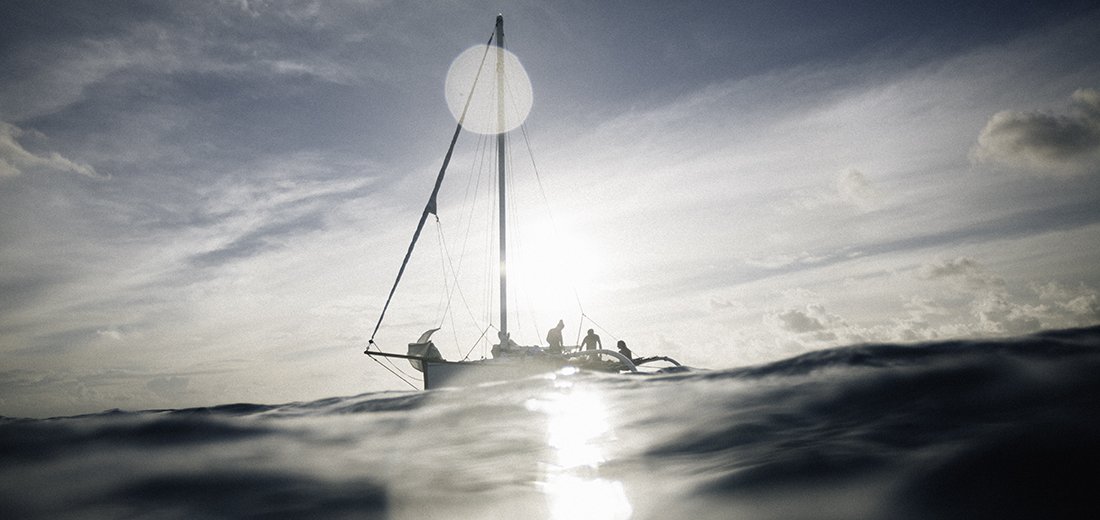
Tara has a history of many adventures. The icebreaking schooner was originally built in 1989 for the French adventurer Jean-Louis Etienne under the name Antarctica. It was acquired by the Cousteau Society in 1999, and was renamed Seamaster by Sir Peter Blake in 2000 for his organization Blakexpeditions. In 2001, Blake set out on a scientific expedition to Antarctica and the Amazon monitoring global warming and pollution for the UN Environmental Programme. In 2003, Seamaster was bought by Etienne Bourgois who renamed it Tara. Between 2006 and 2008 she was deliberately frozen in the arctic ice traveling in the wake of the Norwegian adventurer Fridtjof Nansen and his ship “Fram” for 507 days to study climate change in the arctic.
The current Tara Oceans expedition started in September 2009 and will continue around the planet for three years monitoring and documenting the current state of our precious oceans, creating a kind of global snapshot which can be used as a much needed reference point in environmental studies. A typical sampling station involves collection of plankton using a set of nets with different mesh size as well as pumping of water for filtration and collection of e.g. protists, bacteria, viruses and free nucleic acids and also collection of water samples from various depths. Water samples are usually collected using the CTD (conductivity-temperature-depth profiler) or Rosette, an advanced instrument used to measure physical, chemical and biological parameters down to 2000m.
Imaging of animals from about 5-10mm and larger is done using a macro studio setup developed by Kahi Kai and for smaller specimens (from about 100-200um up to 10-20mm) a Zeiss Discovery stereomicroscope is used. There is also an instrument called a FlowCAM (it’s basically a hybrid between a flow cytometer and a microscope) that automatically takes pictures of plankton from the size of about 10-20um up to about 300um in a water sample. Doing imaging on a moving boat was a real challenge, space is limited and there is both the rocking movement of the boat in the waves and when using the engine there are also vibrations making photography at higher magnifications in the Zeiss microscope impossible. However, thanks to calm conditions, imaging has been fairly easy so far, and after fixing a few technical issues this will be an excellent mobile platform for photographic documentation of the amazing biodiversity hiding beneath the surface of our oceans.
No comments have been added yet!